When Home Office checks the “registration” on a translated marriage certificate, it’s checking whether the translator is a genuine, registered member of a recognised professional body — CIOL, ITI, or the ATC — not the marriage certificate’s own civil registry. Caseworkers can look up a translator’s membership number on that body’s public register. If the translator can’t be found, the certification isn’t independently verifiable, and the translation can be rejected even if every word is accurate.
We’re Marriage Certificate Translations, and in fifteen-plus years of preparing certificates for UKVI, this is the check that quietly decides more applications than people realise. Most applicants focus entirely on getting the wording right. Far fewer ask whether the person signing their certification can actually be found and verified — and that’s the part that determines whether your translation is accepted on the first attempt.
What “Registration” Actually Means Here
The UK has no government register of “sworn” translators the way France, Germany, or Spain do. There’s no state licence number to check, no ministry-issued ID card, and no single official database a caseworker can open and search by law. Instead, registration means membership of a recognised professional body:
- CIOL — the Chartered Institute of Linguists
- ITI — the Institute of Translation and Interpreting
- ATC — the Association of Translation Companies (accrediting agencies, not individuals)
These three organisations maintain public registers precisely so a receiving authority like UKVI can confirm a translator is who they claim to be, without needing any government system at all.
This is easy to miss, because nothing about a signed certification page shouts “check my registration.” The wording looks routine — a name, a signature, a confident statement of accuracy. But that’s exactly what a caseworker is trained to look past when a translation’s credibility needs confirming.
How Caseworkers Actually Verify a Translator’s Registration
When a caseworker reviews your certified translation, they’re not just reading the accuracy statement — they’re checking whether the person who signed it exists as a genuine, findable professional. That means looking up the translator’s name or membership number on CIOL, ITI, or ATC’s public register, in the same way you might look up a solicitor’s practising certificate before trusting their advice.
If the name matches a real, active membership, the certification is treated as independently verifiable, and the check is complete in a matter of minutes. If there’s nothing to find — no matching name, no membership number, no active record — the certification has no professional standing behind it, regardless of how well the translation itself reads. A caseworker isn’t assessing your language skills at this stage; they’re assessing whether someone accountable actually stands behind the document.
| Verifiable Certification | Unverifiable Certification | |
| Signature | Named translator with membership number | Name only, no credential stated |
| Body lookup | Matches a live CIOL, ITI, or ATC record | Nothing found on any register |
| Caseworker outcome | Accepted, no further questions | Flagged, or treated as no certification at all |
What Happens When a Translator Can’t Be Found on Any Register
This is the scenario that catches out self-translations and friend-or-family translations, even when the language work is genuinely excellent.
A signature that says “translated by a native speaker” or “translated by a fluent bilingual friend” carries no registration to check against. There’s no membership number, no professional body, nothing for a caseworker to verify. UKVI guidance is direct that self-translations and translations by relatives are viewed with suspicion precisely for this reason — not because the translation is inaccurate, but because it isn’t independently verifiable. An unverifiable certification is treated the same as no certification at all.
Where Your Translator’s Registration Must Appear on the Certificate
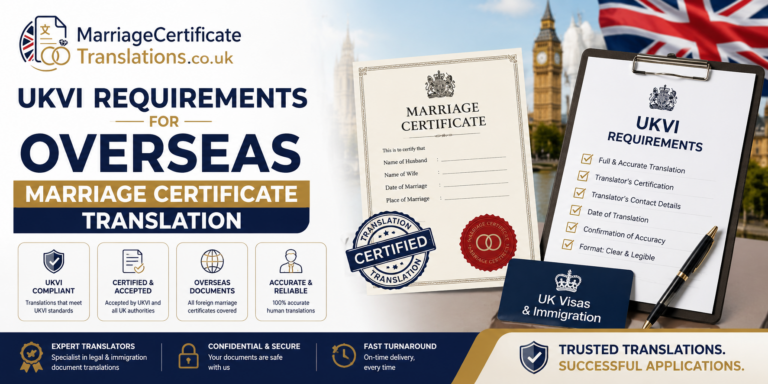
A properly prepared certified translation places the translator’s registration details directly on the certification statement, alongside the elements UKVI already requires:
✅ A confirmation that the translation is accurate and complete
✅ The date the translation was completed
✅ The translator’s full name and signature
✅ Their contact details
✅ Their membership number or professional body affiliation
That last item is the one people forget. It sits right next to the signature, so a caseworker doesn’t have to search for it, guess at it, or contact the translator directly to ask — it’s there to be checked in seconds, exactly where they’re trained to look.
Translated Outside the UK? A Different Rule Applies
If your translator is based outside the UK, there’s an extra layer worth knowing that most applicants only discover once their translation has already been questioned. A translation completed abroad is generally accepted only if one of two things is true:
- The translator is a verified member of an official professional body in their own country of residence
- The relevant foreign embassy has certified the translation as a true copy
Neither of these is automatic, and neither is something a caseworker will chase up on your behalf — it’s the applicant’s responsibility to make sure that link exists before submission. This is exactly why we check a translator’s location and credentials before we ever assign your certificate to them.
Why Every Translator We Have Is CIOL, ITI, or ATC-Registered
Here’s what this means in practice on every certificate we prepare: your translation is assigned to a translator holding genuine, checkable membership with CIOL, ITI, or an ATC-accredited body. That membership number appears on your certification statement, exactly where a caseworker expects to find it, and it points to a real, active, verifiable record — not a name that dead-ends the moment someone tries to look it up. We’re not guessing that this satisfies UKVI — it’s the specific standard our certified translation service is built around, because we’ve watched what happens to certificates that skip this step and land back on an applicant’s desk with a request for further evidence weeks later.
This is also the difference between a translation that gets accepted on its first submission and one that comes back questioned. A caseworker who can verify your translator in under a minute has no reason to pause your file. One who can’t often finds a reason to question everything else in it too — even details that were never actually wrong.
Red Flags That Signal a Translation Won’t Survive This Check
A handful of patterns tell a caseworker, almost instantly, that a certification isn’t independently verifiable:
- ❌ No membership number or professional body named — just a signature and a claim of fluency
- ❌ “Native speaker” listed as the sole qualification — this isn’t a credential a caseworker can look up
- ❌ A translator based abroad with no stated professional affiliation in their own country
- ❌ Missing contact details, which prevents any verification attempt at all
None of these mean your marriage certificate itself is in doubt. They mean the certification behind it has nothing for a caseworker to confirm — and that’s enough to stall an otherwise straightforward application.
Quick Answers
Is “translator registration” the same as the marriage certificate’s registration number?
No. The certificate’s own registration number relates to where your marriage was recorded. Translator registration refers to the translator’s own professional membership with a body like CIOL or ITI — a completely separate check.
Does UKVI require my translator to hold a specific qualification in translation studies?
No. What matters is genuine, verifiable membership with a recognised professional body, not a specific degree or diploma.
Can a bilingual family member’s translation ever pass this check?
No. Even a perfectly accurate translation from a relative has no professional registration behind it, which is exactly what makes it unverifiable to a caseworker.
If my translator is based in another country, does that automatically cause problems?
Not automatically, but it does require an extra step — either verified membership with a professional body in their own country, or embassy certification of the translation as a true copy.
Can you check whether my existing translation was done by a registered translator?
Yes. If you’ve already had your certificate translated elsewhere and aren’t sure whether the translator’s registration would hold up, we’ll check it for you before you submit anything.
Does a higher price automatically mean the translator is properly registered?
No. Price alone tells you nothing about registration status. The only reliable check is whether the translator’s name or membership number actually appears on CIOL, ITI, or the ATC’s public register — ask directly, or have it checked before you submit.
Already Have a Translation? Let Us Check the Registration Behind It
If you’ve had your marriage certificate translated elsewhere and aren’t certain whether your translator’s registration would actually survive a caseworker’s check, send it to us through our quick translator hire form. We’ll confirm whether the certification is genuinely verifiable, at no cost and with no obligation to reorder anything. And if you’re starting fresh, every translation we prepare carries a CIOL, ITI, or ATC-registered translator’s details from the outset — built to be accepted the first time it reaches a caseworker’s desk, not the second.