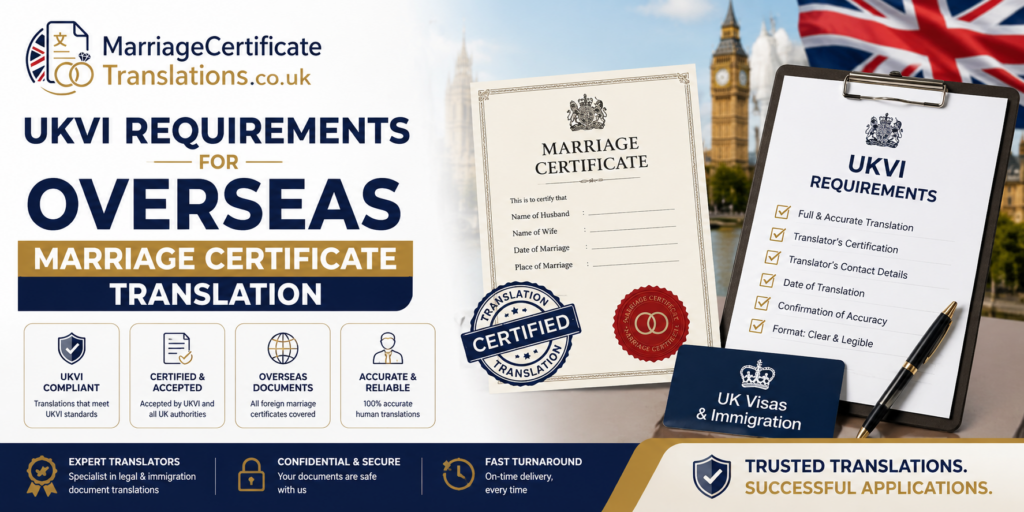
An overseas marriage certificate is UKVI-ready when it’s the correct civil registration document, the marriage passes the Home Office’s legal recognition test, and it’s accompanied by a certified English translation that carries every registration detail accurately. We can confirm the translation and readiness side of that; the legal recognition decision itself always sits with the Home Office.
We’re Marriage Certificate Translations, and this checklist exists because of a pattern we see constantly: applicants order a translation, assume that’s the finish line, and never actually confirm whether the underlying certificate was ready to be translated in the first place. A translation is only as useful as the document behind it. Here’s how we walk every certificate that comes through our door before we hand it back, and how you can run the same check yourself.
Which Scenario Are You In?
Where you start this checklist depends on which of these sounds like your situation:
- You married in a civil ceremony abroad and have one certificate, in one language
- You had a religious or traditional ceremony — Nikah, Hindu ceremony, or similar — and aren’t sure if you’re holding the right document
- You were previously married, and a divorce or death certificate needs to accompany your marriage certificate
- Your certificate is old, handwritten, or partially damaged, and you’re not sure how well it can be translated
- Your certificate uses a different calendar system, such as Hijri dates, that need converting for UKVI
- Your name looks slightly different across your certificate, your passport, and other documents
Most applicants fall into more than one of these at once. That’s normal, and none of them are disqualifying on their own — but each one changes what “ready” actually means for your specific certificate.
The 4-Part Legal Test UKVI Uses to Recognise an Overseas Marriage
Home Office guidance sets out a specific test for whether a marriage conducted abroad counts as legally valid here. Your marriage generally passes if all four are true:
- The type of marriage is recognised in the country where the ceremony took place
- The ceremony was properly conducted according to that country’s own law
- Nothing in either partner’s country of domicile blocks recognition of the marriage
- Any previous marriage has permanently ended — through divorce, annulment, or death — before this one began
Notice what’s missing from that list. It doesn’t ask whether your ceremony looked “official” by British standards, and it doesn’t require you to re-register anything on UK soil. It asks one thing: did this ceremony create a legally binding marriage under the law of the country where it happened? If yes, UKVI recognises it.
What “UKVI-Ready” Actually Means — And What We Can (and Can’t) Confirm
This matters enough that we want to be upfront about it rather than let you assume otherwise.
What we can confirm: whether you’re holding the correct type of certificate, whether your translation carries every field a caseworker would need to check, and whether your documents are internally consistent. This is the “document readiness” side of your application, and it’s exactly what a certified translation service is positioned to get right.
What we can’t confirm: whether Home Office will ultimately recognise your marriage as legally valid. That decision sits with UKVI and, in disputed cases, with an immigration solicitor’s legal opinion — not with any translation provider. Anyone claiming to “validate” your marriage as a paid service is overstating what a translation agency is actually able to do.
We tell you this not to hedge, but because knowing the difference is what actually protects your application — you’ll know exactly which parts of your case we’re strengthening, and which parts genuinely need separate legal advice.
Step 1: Confirm You Actually Have the Right Certificate
Before anything gets translated, we check whether you’re holding a genuine civil registration certificate or a celebration certificate — the decorative document some countries issue at the ceremony itself, which carries no verifiable registration number. We’ve written a full breakdown of that distinction and why it matters for verification, but the short version is this: no translation, however accurate, can make an unregistered document verifiable.
Step 2: Confirm Your Marriage Passes the Recognition Test
This is the legal side we mentioned above. Home Office applies a specific test to overseas marriages — covering where the ceremony took place, how it was conducted, and whether both parties were free to marry. We’ve covered that test in detail separately. Our role here is simpler but still important: we flag anything in your certificate itself that might raise a question against that test, such as a religious ceremony certificate that shows no sign of civil registration.
Step 3: Confirm Your Translation Is Actually UKVI-Compliant
This is where we spend most of our attention, because it’s the step entirely within our control — and the one most likely to go wrong when handled by someone unfamiliar with immigration documents.
A compliant certified translation needs the standard four elements — a signed accuracy statement, date, translator’s name and signature, and contact details. But there’s a second layer that matters just as much and gets missed constantly: consistency across every document you submit. If your marriage certificate, your divorce decree, and your birth certificate were each translated by different providers at different times, terminology, name spellings, and formatting can drift between them — and a caseworker comparing documents side by side will notice. We handle this by using one translator across your full set of documents wherever possible, specifically to avoid this kind of self-inflicted inconsistency.
Step 4: Check Your Supporting Evidence Lines Up
Beyond the certificate itself, we check whether your name appears the same way across your passport, your certificate, and any other identity documents you’re submitting. A transliteration difference between scripts is usually harmless and explainable; an unexplained discrepancy is the kind of thing that generates a caseworker query. We flag this before you submit, not after you get a request for further information.
Step 5: Confirm Any Country-Specific Extra Step
Some countries carry an additional local registration step — a Union Council certification for a Nikah Nama in Pakistan, for instance, or registration under the Hindu Marriage Act in India. We know these requirements by country because we handle certificates from these jurisdictions routinely, and we’ll tell you if your certificate is missing that step before you pay for translation, not after.
The Complete UKVI-Readiness Checklist
Run through this before you submit anything:
✅ You’re holding a civil registration certificate, not a celebration certificate
✅ Your marriage meets the Home Office’s legal recognition test for the country where it took place
✅ Your translation includes the accuracy statement, date, translator’s name and signature, and contact details
✅ Registration numbers, registrar details, and seals are carried across in full, not summarised
✅ Names match consistently across your certificate, passport, and other submitted documents
✅ Any previous marriage is accounted for with its own translated divorce or death certificate
✅ Any country-specific local registration step has been completed
✅ All your documents were translated with consistent terminology and formatting
If every box is genuinely ticked, your certificate is ready to go in.
Who Should Prepare This Check — And Why Credentials Matter
The UK doesn’t operate a government “sworn translator” register the way some European countries do. Instead, certification rests on the translator’s own signed statement, which is why the translator’s professional accountability matters so much. We work to standards set by bodies like CIOL, ITI, and the ATC precisely because a certification is only as credible as the person signing it — and a caseworker checking your file is, in effect, trusting that signature.
How We Help You Get Certificate-Ready
Here’s specifically what we do, beyond just producing a translated document:
- We check your certificate type first, before you commit to a translation, so you’re not paying to translate the wrong document
- We flag legal-recognition risk points we spot in the certificate itself, so you know to seek legal advice early if needed
- We translate every registration detail in full — registration numbers, registrar names, seals — because these are what a caseworker cross-checks
- We keep one translator across your full document set where possible, to avoid the inconsistency that comes from mixing providers
- We cross-check your name spelling across the documents you’re submitting alongside your certificate
- We tell you about country-specific extra steps relevant to your certificate’s country of issue, before submission, not after a query
None of this replaces legal advice on complex cases. What it does is make sure the part of your application that’s within our control — the certificate and its translation — is genuinely ready, not just translated.
Quick Answers
If my translation is perfect, does that guarantee my marriage will be recognised?
No. A perfect translation confirms your document is readable and verifiable. Whether the marriage itself is legally recognised is a separate question decided by Home Office, based on the law of the country where you married.
Can you tell me for certain whether my marriage will be accepted?
We can flag anything in your certificate that looks like it might raise a question against the recognition test, but a definitive legal opinion on a disputed case should come from an immigration solicitor, not a translation provider.
Do I need every document translated by the same provider?
It’s not a strict requirement, but it significantly reduces the risk of inconsistent names, dates, or terminology across your submission — which is why we recommend it wherever practical.
What if my certificate is handwritten or partially faded?
We can usually still translate it, provided the key details remain legible. If sections are genuinely unreadable, we’ll tell you before starting, rather than guessing at content.
Will you tell me if my document isn’t ready, even if it means I don’t order a translation yet?
Yes. If your certificate turns out to be the wrong type, or missing a step that would waste the cost of translation, we’ll tell you that upfront rather than translate it anyway.
Get Your Certificate Reviewed Before You Order Anything
Run this checklist against your own certificate, and if anything’s unclear, send us a photo through our quick translator hire form before you pay for a single translation. We’ll tell you honestly whether your certificate is ready, what’s missing, and what we can do about it — the same review we’ve built into every certificate we’ve handled for UKVI, the Home Office, and UK courts over fifteen-plus years.