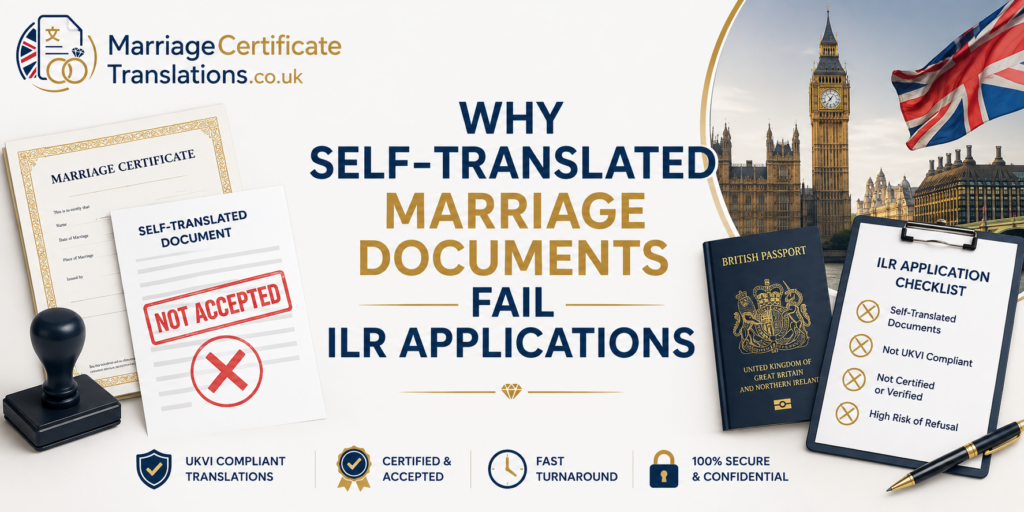
A self-translated marriage certificate often survives a spouse visa application but fails at Indefinite Leave to Remain (ILR) because ILR reviews your entire five-year immigration history at once, not a single document in isolation. A translation with no verifiable certification, or one that’s inconsistent with the other documents built up over five years, is far more likely to be flagged at this final, higher-scrutiny stage than it was the first time around.
We’re Marriage Certificate Translations, and over fifteen-plus years of handling ILR cases, we’ve seen this exact pattern more times than we can count: an applicant whose spouse visa went through fine, now filing for settlement, suddenly worried about a certificate they translated themselves five years ago. That worry is usually justified, and here’s exactly why.
Why ILR Scrutiny Works Differently From Your Original Spouse Visa Check
Your spouse visa application was assessed as a single point in time — one certificate, one relationship snapshot, one set of documents. ILR is assessed as a five-year story. A caseworker isn’t just checking your marriage certificate again; they’re checking it against every extension application, every address change, every piece of evidence you’ve submitted since, looking for a consistent thread running through all of it.
This changes what “acceptable” means. A document that only had to stand on its own at the spouse visa stage now has to remain consistent with years of accumulated paperwork. A weakness that was survivable in isolation becomes far more visible in context. For the latest settlement requirements, check the official GOV.UK guidance for Indefinite Leave to Remain applications.
The False Security of “It Worked Last Time”
This is the trap almost every applicant in this situation falls into. If your self-translated marriage certificate didn’t cause a problem at the spouse visa stage, it’s natural to assume it’s fine.
But passing through once doesn’t mean it was ever properly verified. Spouse visa applications are often approved on the strength of the overall relationship evidence — photos, messages, joint finances — even when a supporting document like a translation wasn’t ideal. The certificate wasn’t necessarily checked and cleared; it may simply not have been the deciding factor that time. ILR gives a caseworker a much bigger, much more detailed file to compare it against, and a five-year-old weakness that went unnoticed once doesn’t get a second pass automatically.
Why a Self-Translated Marriage Certificate Gets Caught Specifically at This Stage
Three things happen over five years that specifically increase the risk for an old self-translated certificate:
- More documents exist to cross-check it against. Your name, your spouse’s name, and key dates now appear across five years of extension paperwork, tenancy agreements, and financial records. Any inconsistency the original translation introduced has more places to surface.
- The certification itself is older and harder to trace. If your self-translation had no verifiable credential behind it in the first place, five years hasn’t made it any more traceable — if anything, informal arrangements (a friend, a relative, a since-closed business) become harder to follow up on the longer the gap.
- ILR is explicitly a full-history review, not a fresh-start application. UKVI is confirming your entire settlement journey has been consistent and genuine, and a document that was never independently verifiable remains a gap in that story, however long ago it was submitted.
What Actually Happens When ILR Flags an Old Self-Translated Document
If a caseworker flags your certificate at this stage, one of two things typically follows. You may receive a request for further evidence, giving you a set window to submit a properly certified translation before a decision is made. Or, in a more serious case, your application can be refused outright on the basis that the supporting evidence for your relationship history isn’t sufficiently verifiable.
Either outcome costs you time you don’t get back easily — a refusal at ILR stage is far more disruptive than a delay at spouse visa stage, since your existing leave may be closer to running out and a fresh application means starting the clock again on a five-year wait, or worse.
Can a Self-Translated Marriage Certificate Be Fixed Before You Submit?
Yes, and this is the most important thing to know if you’re reading this before you’ve filed. A self-translated certificate can be replaced with a properly certified translation at any point before submission — there’s no rule against retranslating an old document. What matters is doing it before a caseworker raises it, not after.
What We Check on a Five-Year-Old Self-Translated Certificate
When someone brings us a certificate that was self-translated years ago for an original spouse visa, we don’t just retranslate it. Our certified translation service runs a specific check for exactly this situation:
- We confirm the certificate itself is still legible and complete enough to retranslate accurately
- We check whether names and key details in the new translation align with what’s already on file in your other ILR documents
- We produce a translation with full, verifiable certification — translator name, signature, contact details, and professional registration — so there’s nothing for a caseworker to question this time
- We flag, before you submit, if anything else about the certificate looks likely to raise a query
How Our Certified Translation Service Helps with Your ILR Application
Here’s the number that changes how most people think about this: the ILR application fee is £3,029 per applicant. That’s what’s on the line if a caseworker can’t verify your marriage certificate translation at this stage — not a delay you can shrug off, but a fee you don’t get back, months of waiting to reapply, and a settlement timeline pushed back at the exact point you thought you were done. We’ve sat with applicants after that refusal letter arrives, and it’s a conversation we’d rather help you avoid having.
This is why we handle ILR cases differently from a first-time spouse visa translation. When your certificate comes to us, here’s exactly what happens:
We read your certificate against what a caseworker will actually check. Registration number, registrar details, seals — every field that ties your document to a verifiable record gets carried across in full, not summarised. We’ve seen five-year-old self-translations where a stamp was left out because it “looked decorative.” That single omission is enough to stall a settlement application.
We put a real, checkable name behind your certification. Every translator we use is registered with CIOL, ITI, or an ATC-accredited body, and that membership appears on your certification statement. A caseworker can verify it in minutes — which means there’s nothing left for them to question, and nothing left for you to worry about.
We check your certificate against your other documents, not just against itself. If your name is spelled one way on your original certificate and another way on five years of extension paperwork, we catch that before submission, not after a query letter arrives. This cross-check is something a translator working on your certificate alone, with no visibility into your wider file, simply can’t do.
We tell you the truth about your document, even if it costs us the sale. If your existing certificate is genuinely too damaged to retranslate accurately, or if the underlying document itself looks like it might raise a separate issue, we say so upfront. We’d rather you know now than find out from a Home Office letter in six months.
If you’re staring down an ILR filing deadline with a certificate you translated yourself, or one a friend did years ago, this is the point where it’s worth asking a straightforward question: is saving a few hundred pounds on translation worth risking £3,029 and a year of your life on a reapplication? For most people filing for settlement, the answer is no — and that’s exactly the gap we exist to close.
Red Flags in an Old Self-Translated Document That Signal ILR Trouble
Before you submit your ILR application, check your existing certificate translation against these:
- ❌ No translator signature, or a signature with no professional body named
- ❌ No accuracy statement confirming it’s a complete, true translation
- ❌ Name spellings that don’t match your passport or other ILR documents exactly
- ❌ A translation done by a friend, relative, or yourself, however accurate the wording is
- ❌ Missing dates, registration numbers, or stamps that were left out as “unnecessary”
Any one of these is worth fixing before you file, not after a caseworker asks about it.
Quick Answers
If my spouse visa was approved, does that mean my translation was already accepted as valid?
Not necessarily. Approval often rests on your overall relationship evidence, not a document-by-document clearance. A weak translation can go unchallenged the first time and still be flagged later.
Can I submit the same self-translated Marriage certificate again for my ILR application?
You can, but it carries the same risk it always did, and ILR’s full-history review makes that risk more likely to surface than it was originally.
How long does it take to get an old certificate professionally retranslated before I file?
This depends on the language and certification type required, but it’s worth starting well before your ILR filing deadline rather than leaving it until the last minute.
Will retranslating my certificate now draw attention to the fact that the first one was self-translated?
No. Submitting a properly certified translation with your ILR application is standard practice — there’s no requirement to explain or disclose how a document was translated previously.
What if my original certificate has degraded or become harder to read after five years?
Let us know before you send it. We’ll tell you honestly whether it can still be retranslated accurately, rather than guessing at unclear sections.
Filing for ILR? Get Your Old Certificate Checked First
If your marriage certificate translation was done by yourself, a friend, or a relative five years ago, don’t wait for a caseworker to raise it. Fill in our quick translator hire form and send it to us before you file — we’ll tell you honestly whether it needs replacing, and prepare a properly certified translation that stands up to the full-history review ILR is built around. No obligation, just clarity before it matters.