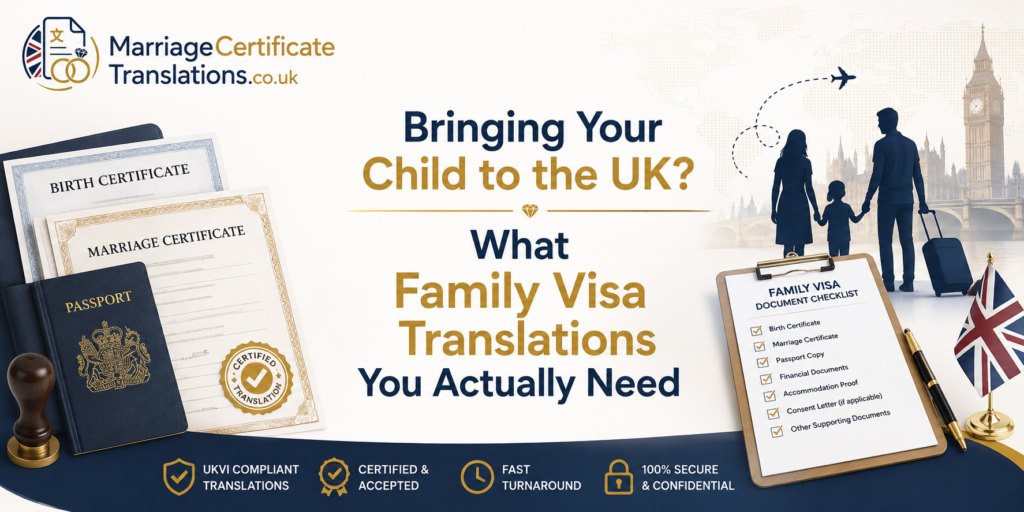
A UK family visa application typically needs certified translations for your child’s full birth certificate, a consent letter if only one parent is applying, any custody or guardianship documents, your marriage certificate, and financial evidence not already in English. Each document serves a different purpose in proving the relationship and eligibility, and inconsistencies between them are one of the most common causes of delay.
We’re Marriage Certificate Translations, and family visa cases are different from almost anything else we handle. A spouse visa involves one applicant and one certificate. A family visa often means several people, several document types, and several languages — and every one of those documents has to tell the same consistent story to a caseworker. After fifteen-plus years translating for UK family applications, here’s exactly what’s needed, when, and why — and where families most often go wrong without realising it.
For the latest UKVI requirements, check the official GOV.UK guidance on the information and evidence required for family visa applications.
Which Family Members Need Documents Translated for a UK Family Visa — And When
A UK family visa covers a partner and any children under 18 joining a parent who’s settled or has permission to stay in the UK. Each person’s documents come into play at a different point:
- At the initial application — birth certificates, consent letters, and marriage certificates establish who’s related to whom
- At extension stage — evidence of ongoing family life and finances
- At Indefinite Leave to Remain — the same core documents, reviewed again alongside years of accumulated evidence
Timing matters more than most applicants expect. Applications made from outside the UK typically take up to 12 weeks to process; applications made from inside the UK generally take up to 8 weeks. A translation that’s missing, incomplete, or queried by a caseworker doesn’t just delay your paperwork — it adds directly to how long a family stays apart. Knowing which stage you’re at, and which documents actually need translating now, saves time you can’t easily get back.
Your Child’s Birth Certificate for a UK Family Visa: Why It’s Needed
A full birth certificate is the primary document proving a child’s relationship to their parent, and it’s required for almost every family visa case involving a child. Without it, there’s no reliable evidence linking the child to the sponsoring parent at all.
Here’s the detail that catches families out: many countries issue two versions of a birth certificate — a short-form certificate, which shows only the child’s name and date of birth, and a full-form certificate, which shows both parents’ names. UKVI needs the full version, because the short form doesn’t actually prove the parental relationship the application depends on. Translating a short-form certificate perfectly doesn’t fix this — the underlying document simply doesn’t contain what’s needed. Check which version you’re holding, and if necessary, request the full-form certificate from the issuing authority, before you send anything for translation.
The Consent Letter: When Only One Parent Is Applying, and Why UKVI Asks for It
If only one parent is bringing the child to the UK, UKVI needs to know the other parent agrees, or an explanation for why their consent isn’t available. This applies in divorce situations, where one parent remains abroad, or where parental responsibility is shared but only one parent is relocating.
This letter, if written in a language other than English, needs certified translation just like any other supporting document. It’s easy to overlook because it doesn’t feel like an “official” document the way a birth certificate does — but UKVI treats it as essential evidence, and a missing or untranslated consent letter is a common cause of delay. If consent genuinely can’t be obtained, that explanation itself needs to be clear, translated if necessary, and supported by evidence of the circumstances — a vague or unexplained gap tends to draw more scrutiny than a fully documented one.
Custody and Guardianship Documents: Why They’re Requested and in Which Cases
Where a child’s living arrangement isn’t straightforward — divorced parents, a legal guardian, or a stepchild joining a step-parent — UKVI expects documentation that establishes who holds legal responsibility. This typically means a court order, a custody agreement, or formal guardianship paperwork, translated in full if issued in another language.
Not every family needs this. It applies specifically where the child isn’t travelling with both biological parents together, or where legal responsibility sits with someone other than a biological parent. If this doesn’t describe your situation, there’s no need to source or translate anything extra here — adding documents UKVI hasn’t asked for doesn’t strengthen an application, it just adds pages for a caseworker to work through.
Marriage and Financial Documents for a UK Family Visa Application
A marriage certificate establishes the relationship between the sponsoring parent and their partner, and financial documents — payslips, bank statements, employer letters — prove the income requirement is met. Both need certified translation if not already in English. We’ve covered what makes a marriage certificate translation UKVI-compliant in detail elsewhere; the same certification standard applies here. These documents may also be required as part of a UK family visa application.
Why UK Family Visa Document Inconsistencies Cause Delays
A family application rarely fails because one document is wrong. It fails because the documents don’t agree with each other. A child’s name spelled one way on their birth certificate and another way on their passport. A parent’s name that doesn’t match between the marriage certificate and the consent letter. A date of birth that’s transposed between two translated documents.
Each document might individually be accurate and properly certified, and the application can still be flagged, because a caseworker is checking the full family picture against itself, not reading each document in isolation.
Why UK Family Visa Applicants Trust Us for Certified Translations
Here’s what a family application usually needs translated, in one place:
- ✅ Child’s full birth certificate
- ✅ Consent letter (where only one parent is applying)
- ✅ Custody or guardianship documents (where applicable)
- ✅ Marriage certificate
- ✅ Financial documents not already in English
The risk with family applications isn’t any single document — it’s coordinating several of them, from different sources, without anything drifting out of sync. This is exactly where we focus:
| Requirement | Self-Translated or Mixed-Provider Documents | Marriage Certificate Translations |
|---|---|---|
| Certification verifiable | Often no professional registration behind it | Every translator registered with CIOL, ITI, or the ATC |
| Consistency across family documents | Names and dates can drift between providers | One translator handles your full document set |
| Sensitive cases (custody, single parent) | Handled generically, if at all | Reviewed with direct experience of these exact situations |
| Risk of caseworker query | Higher, especially across multiple documents | Minimised by checking documents against each other before submission |
We assign one translator to a family’s full set of documents wherever possible, specifically so a child’s name reads identically on their birth certificate translation as it does on their consent letter translation, and a parent’s name matches exactly between the marriage certificate and every other document in the set. That’s not a courtesy — it’s the detail that keeps a caseworker from having a reason to pause your file, and it’s why families with more than one document to translate tend to come to us rather than splitting the work across different providers.
Quick Answers
Do all my children need separate certified translations, or can one cover the whole family?
Each child’s documents need their own translation, since each certificate is a distinct legal document. What matters is consistency between them, which is why we recommend one translator for the full set.
My child’s birth certificate only shows my name, not the other parent’s. Is that a problem?
It can be. If the certificate is a short-form version, UKVI may not accept it as sufficient proof of the parental relationship. Check whether a full-form certificate is available before applying.
Does a consent letter need to be notarised as well as translated?
Not automatically. UKVI’s core requirement is a certified translation if the letter isn’t in English. Additional notarisation depends on your specific case and is worth confirming if you’re unsure.
What if the other parent refuses to provide consent?
You can submit an explanation with supporting evidence instead, such as evidence of sole responsibility. This is a case-specific situation worth discussing with an immigration adviser.
Can you translate documents for multiple family members in one order?
Yes. This is exactly the kind of case we’re set up for — a full family set translated and certified together, with consistent names and dates throughout.
Ready to Submit? Let Us Review Your Family’s Documents First
Before you pay for a single translation, send us what you have — birth certificates, consent letters, custody papers, marriage certificate, whatever applies to your case. We’ll tell you honestly which documents actually need translating, which version of each one UKVI expects, and whether anything looks likely to raise a query, all before any work begins and at no cost to you.
Every certificate we produce is checked by a second reviewer before it’s signed off, not just the translator who prepared it — a second pair of eyes on names, dates, and registration details, specifically because family cases have more room for something small to slip through. And if a caseworker ever does come back with a question about how we’ve certified a document, we’ll deal with it directly and put it right, at no extra charge.
We’ve built our reputation on UK immigration solicitors and family law practitioners referring their own clients to us, which happens for one reason: the translations hold up. Fill in our quick translator hire form and let’s get your family’s documents ready properly, the first time.