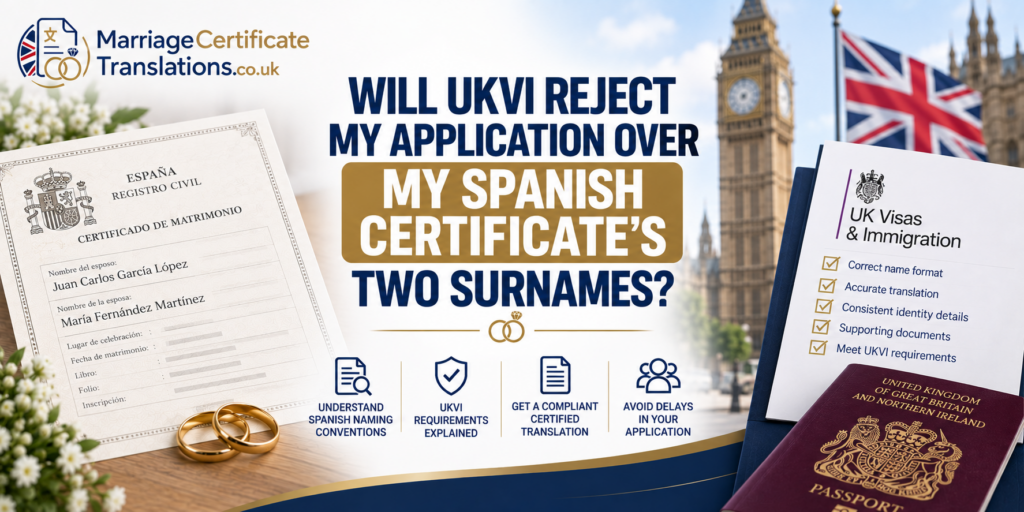
⚡ Quick Answer: A Spanish marriage certificate two surnames structure is normal, not an error: every person in Spain and most of Latin America legally carries two surnames, traditionally the father’s first and the mother’s second, and both must appear in full in a certified English translation. Spanish women do not take their husband’s surname on marriage, so an acta de matrimonio will never display a married name, which is what triggers apparent mismatches against UK passports and application forms. UK authorities require a complete translation covering every field, seal and marginal note, and dropping the second surname to fit a UK form is the single most common cause of a caseworker query. Where a genuine difference exists between documents, a translator’s explanatory note resolves it far more reliably than silent omission.
You’ve filled in a UK form with one surname box, and your certificate lists four surnames across two people. Nobody has told you which one is “yours”, and the quiet worry sets in that a caseworker will decide your documents don’t match.
Our specialists at Marriage Certificate Translations hear this every week from Spanish, Mexican, Colombian and Argentinian clients. The reassuring news is that nothing is wrong with your document. The problem is that two record-keeping systems are meeting each other, and only one of them is being read by the person assessing your application.
Why Your Certificate Shows Four Surnames For Two People
In Spain and across Hispanic America, a surname isn’t a single inherited label. Everyone carries two: traditionally the first from the father and the second from the mother, though in Spain parents have been able to choose the order for some years now. Neither is a middle name. Neither is optional. Together they form one legal identity, and the civil registry records both because that’s what identifies you in the register.
This is why your acta de matrimonio names four surnames. It is describing two people completely, in the only format the Registro Civil recognises.
The Detail That Causes Nearly Every Uk Mismatch
Here’s the part that catches British partners and UK caseworkers alike: Spanish women don’t change their surname when they marry. There is no maiden-name-to-married-name transition in the Spanish system at all. A woman keeps the two surnames she was registered with at birth for her entire life.
So your certificate will show her birth surnames, permanently, with no married name anywhere on the document. To someone reading it against a UK application listing a married surname, that looks like a contradiction. It isn’t. It’s two legal traditions doing entirely different things.
⚠️ CRITICAL LEGAL WARNING: Never ask a translator to “simplify” the names to match your UK paperwork. Dropping a second surname, or substituting a married name that doesn’t appear on the original, turns an accurate document into an inaccurate one. A certification statement declares the translation is complete and faithful, and a translation that quietly edits identity details cannot honestly carry that declaration.
How To Get Your Spanish Certificate Translated Without A Name Query
In our years of preparing Spanish civil registry documents for Home Office compliance, we’ve found the outcome is decided before translation starts. Follow this sequence.
1 ➔ Order the full registry version, not a summary. Request the complete transcription of the register entry rather than an abbreviated extract. The full version carries the registration details, the registrar’s endorsement and any subsequent annotations. A summary omits exactly the fields a caseworker cross-references, and you’ll be asked for the full one anyway.
2 ➔ Photograph or scan every page, both sides. Spanish and Latin American registry documents frequently carry stamps, seals and handwritten registrar signatures on the reverse. Capture the whole document in daylight with all four corners visible, so nothing has to be guessed at.
3 ➔ Send your passport spelling at the same time. Tell your translator exactly how your name appears on your passport and on your UK application, including whether any surname is hyphenated there. This single step prevents most queries, because it lets the difference be handled deliberately rather than discovered later.
4 ➔ Ask for both surnames to be carried across in full. Every surname on the original belongs in the translation, in the original order, spelled as registered. Accents, tildes and the letter ñ stay exactly as they appear, because altering them changes the name.
5 ➔ Request a translator’s note where a genuine difference exists. Where your passport shows one surname and the certificate shows two, or where a name has been recorded differently, a short explanatory annotation on the translation tells the reader why. Our legal translation experts add these routinely, and they resolve in one line what would otherwise become a request for further information weeks later.
6 ➔ Confirm the marginal notes have been included. More on those below, because they’re the second thing that goes wrong.
Which Version Of Your Spanish Certificate Do You Actually Need
We frequently see applicants get caught out by ordering the wrong document from the registry, then paying to translate something that gets rejected.
| Version | What it contains | Where it stands up |
|---|---|---|
| Full literal certification | A complete transcription of the register entry, including registration references, registrar details and every marginal annotation | The safest choice for UK submissions where full detail is cross-checked |
| Summary extract | A condensed statement of the key facts only, with annotations omitted | Fine for informal purposes, frequently insufficient for official UK use |
| Multilingual extract | A standard-format extract issued in several languages under a 1976 international convention | Accepted without translation only in the states party to that convention, which does not include the UK |
That third row surprises people constantly. Holding a multilingual certificate feels like it should end the conversation, and for movement between certain European countries it does. For a UK submission it generally doesn’t, because the arrangement that makes those extracts translation-exempt simply doesn’t extend here. If English isn’t printed on the document itself, assume you need a certified translation and confirm with the authority receiving it.
The Marginal Notes Almost Everyone Forgets
Spanish registry entries don’t stop on the wedding day. Later civil-status events are added to the same entry as notas marginales, so a certificate issued years afterwards can carry annotations recording changes registered since.
What court officials rarely tell you is that an incomplete translation of an annotated document reads as evasive rather than careless. Those notes sit on the original, and a translation that renders the main body while ignoring the margins isn’t a complete document. Every annotation, however brief, belongs in the English version, along with a clear indication of where it sits on the page.
Frequently Asked Questions
Which Of My Two Spanish Surnames Is My Legal Surname In The Uk?
Both are, taken together. UK systems often store the first surname as the family name and treat the second as an additional name, but neither is legally droppable, which is why the translation must show both.
Do Spanish Women Change Their Surname After Marriage?
No. Spanish and most Latin American women keep their registered birth surnames permanently, so no married name is ever added to the civil record.
Should A Translator Keep Both Surnames Or Drop One?
Keep both, in the registered order. A translator who removes one to make the document tidier has produced something that no longer matches the original.
Will Ukvi Reject My Application If The Names Don’T Match My Passport?
An explained difference is very different from an unexplained one. Flag it before translation so it can be addressed on the document itself rather than left for a caseworker to interpret.
Do The Marginal Notes On My Spanish Certificate Need Translating?
Yes, all of them. Their presence is part of what makes the certificate current, and omitting them leaves the English version incomplete.
My Spanish Certificate Is Multilingual, Do I Still Need A Certified Translation For The Uk?
Usually yes, unless English appears on the document itself. Confirm with the body you’re submitting to before assuming the multilingual format is enough on its own.
Do Latin American Certificates Follow The Same Surname Rules As Spain?
Broadly yes across Mexico, Colombia, Argentina, Peru, Chile, Ecuador and Venezuela, though registry formats and terminology vary country by country. The two-surname principle holds.
Can A Translator Add A Note Explaining The Surname Structure?
Yes, and it’s one of the most useful things a certified translation can carry. It’s an explanatory annotation, clearly marked as the translator’s, never a change to the original text.
Does The Ñ Or An Accent In My Surname Cause Problems?
Only when someone strips them out. Characters are reproduced as registered, and where a UK system has recorded a stripped version, that’s precisely the difference a translator’s note should explain.
What If My Certificate Is Old Or Handwritten?
Older Latin American and Spanish registry entries are often handwritten and can be translated normally, provided the key fields remain legible. Illegible sections are marked as such rather than guessed at.
Final Thoughts
Almost every Spanish name problem we’re asked to fix started with someone trying to make the document look simpler than it is. Your certificate isn’t wrong, and it doesn’t need tidying. It needs translating completely, and it needs one short note explaining what a UK reader is looking at. Get those two things right and the surnames stop being a problem at all.